
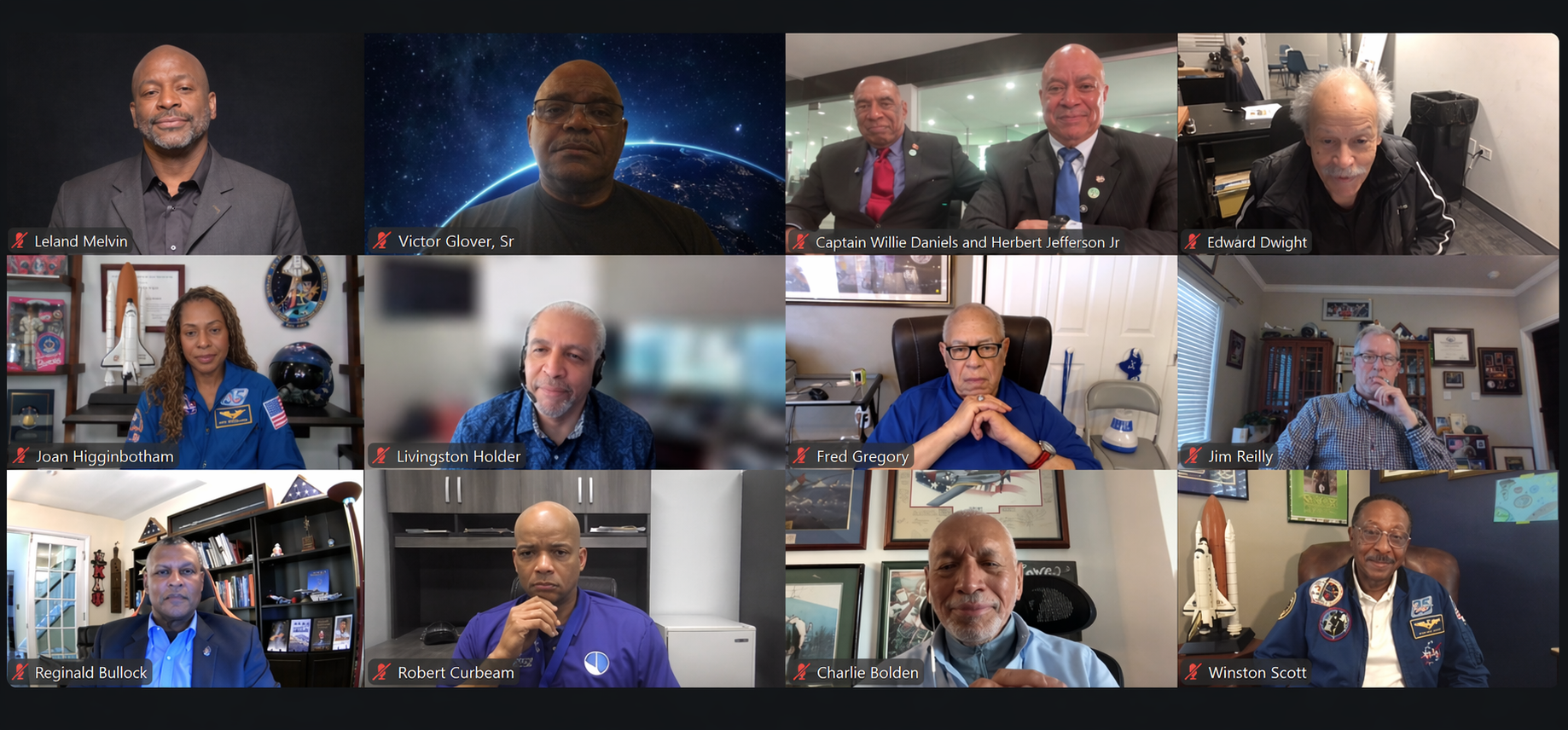
2nd Row: Joan Higginbotham, Livingston Holder, Fred Gregory, Jim Reilly
Bottom Row: Reginald Bullock, Robert Curbeam, Charlie Bolden, Winston Scott
In the wake of Artemis II’s historic return from its mission around the moon, some of the nation’s most accomplished Black astronauts, engineers, and aerospace pioneers came together for an intergenerational conversation about perseverance, representation, and the future of space exploration. The discussion became a meditation on history, possibility, and the cultural significance of who now gets to shape humanity’s future beyond Earth.
The April 10 landing marked the first crewed journey into deep space since Apollo 8 in 1968. The mission also made history as the first to carry a woman, Christina Koch, a person of color, Victor Glover, and a non-U.S. citizen, Canadian Jeremy Hansen, around the moon, setting a new human deep-space distance record. Mission commander Reid Wiseman led the groundbreaking crew, whose achievement signaled not only technological progress but a profound cultural shift.
The online gathering was convened by Captain Willie Daniels (ret.), who has 48 years of association with United Airlines and founder of SHADES OF BLUE, a nonprofit dedicated to introducing young people of color to aviation and aerospace careers. The moment carried special meaning for Daniels because Artemis II pilot Victor Glover, Jr. was among SHADES OF BLUE’S earliest graduates.
Moderated by Reginald Bullock, the conversation featured a cohort of aerospace trailblazers, including pioneering astronaut Ed Dwight; astronauts Winston Scott, Robert Curbeam, Joan Higginbotham, Jim Reilly, Leland Melvin, Charles Bolden, Frederick Gregory, Livingston Holder and Herbert Jefferson Jr., best known for his role as Lieutenant Boomer on the original Battlestar Galactica television series. Together, they represented decades of progress, struggle, and excellence in American aerospace.
Victor Glover Sr. started the conversation by recounting his son’s early years. He recalled encouraging the younger Victor to pursue becoming a Navy pilot instead of a Navy SEAL—a pivotal decision that ultimately placed him on the path to NASA. Even now, Glover said, the magnitude of his son’s journey remains surreal, filled with pride, excitement, and the nervous awe of watching history unfold through family.
“It’s exciting, it’s nerve-wracking and it makes me quite anxious. But I’m enjoying every minute of it,” Glover said.
A generational perspective was shared by Ed Dwight, who in 1961 was selected by President John F. Kennedy to become America’s first Black astronaut. Though denied the chance to fly during NASA’s early years, Dwight ultimately fulfilled that dream decades later aboard Blue Origin’s New Shepard, becoming America’s oldest astronaut at age 90. Reflecting on Artemis II, he noted how dramatically both science and opportunity have evolved since the 1960s.
“They got the right guy to do what I could have and would have done had I had the chance,” Dwight said. “There’s so much science that has transpired since I was involved, and there’s so much more to observe now in the science of space.”
Former NASA Administrator Charles Bolden, nomination by President Barack Obama and the first African American to lead the agency, reflected on his own path through the segregated South. He described how entry into the Naval Academy and later test pilot school once felt nearly impossible. His message to young people was clear: follow your passion, and when given leadership, take care of your people.
That theme of internal belief was reiterated in the reflections of astronaut Joan Higginbotham. As one of the few African American women to travel into space, she spoke candidly about repeatedly finding herself as “the only one” in classrooms, labs, and professional spaces. The greatest challenge, she said, was learning to know she belonged. Once she overcame that barrier, her journey became larger than personal success—it became a visible pathway for others.
“As one of the few African American women to travel to space, I’m deeply aware that my journey carries meaning beyond my own experience,” Higginbotham said. “It speaks to visibility, to access, and to the importance of expanding what people believe is possible for themselves.”
Leland Melvin’s story added another layer of resilience. After losing his hearing in a training accident and being told he would never fly in space, he leaned on childhood lessons of persistence and the support of trusted advocates who refused to let him quit. That belief carried him through two missions and remains central to how he now thinks about legacy: ensuring young people can see themselves in the story of space.
What makes Artemis II feel different, several panelists agreed, is that the mission transcends science alone. Winston Scott described it as a cultural breakthrough—one in which audiences are no longer primarily focused on race, gender, or nationality, but on the crew’s shared excellence and precision. In that sense, the mission represents not only a triumph of engineering but the visible erosion of long-standing social barriers.
Still, the group emphasized that symbolic breakthroughs must be followed by sustained action. Frederick Gregory, NASA’s first Black acting administrator, stressed the importance of moving quickly into Artemis III and Artemis IV so public imagination and momentum are not lost. Continuous progress toward lunar rendezvous, docking operations, surface research, and eventual missions to Mars will determine whether Artemis II becomes a lasting legacy or a singular exception.
“I hope that we’re able to follow this with a quick Artemis III to work on the rendezvous and dockings with Blue Origin and SpaceX,” Gregory said. “And then Artemis IV to get us back on the moon again as the beginning of the first adventure in the journey to get to Mars and beyond.”
Bolden expanded that responsibility is beyond NASA, it’s calling on scientists, astronauts, and citizens alike to become advocates for space exploration. Sustained public enthusiasm must translate into congressional support and long-term funding if the promise of lunar permanence and Martian exploration is to be realized.
The cohort agreed that inspiration is the ultimate mission. Children need to see people who look like them talking about flying jets, designing rockets, and building future colonies beyond Earth. The most enduring legacy of Artemis II may not be the distance traveled, but the horizons expanded in the minds of the next generation.
Click HERE to view this historic conversation in its entirety.